I can't claim to be 'objective' or neutral on health-care reform -- but who can? Everybody needs health care, some more than others. I need it less than most, as my family and I are, knock on wood, generally blessed with good health. Even so, we laid out $18K last year for health care, still owe money -- and no one in the family ever entered an ER, got a scan, received a prescription costing more than $100, or got admitted to a hospital. And we're among the lucky ones who can (supposedly) afford insurance. (We pay $10K for a plan with a $5K deductible.) This is one of several reasons I'm profoundly dissatisfied with the health-care system we have and recognize what should be obvious: We need major health-care reform in this country.
So why, as a country, do we seem so determined NOT to get it? Or rather, why does Congress seem so determined to not fix something so clearly broken? If a foreign government were causing 45 million Americans to go without health care while driving tens of thousands of others into bankruptcy, we'd be on this thing. Apparently it's okay, however, if we do this to ourselves. And as of this week, the buzz is that Obama's efforts to reform health-care are in serious trouble because of a lack of Congressional support. (Never mind htat polls show the public overwhelmingly supports his efforts.) Why is Congress falling down?
Nate Silver at FiveThirtyEight, the site that rose to prominence handicapping the 2008 presidential race, has a very illuminating piece on suggesting at least part of the answer. He breaks down how different health-care special interest money appears to affect the support given the public-plan options by different types of politicians (i.e., liberal dems v mainline dems v 'centrist' dems v centrist GOPers). Bottom line: the money seems to have the most sway over 'centrist' or 'mainline' Democrats who are from regions with high per-capita levels of health-care spending.
Pretty damned interesting. But:
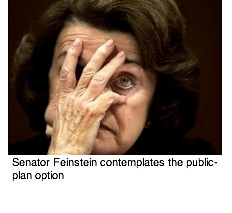
He then includes a chart showing those whose votes have likely been most swayed. Here's where to look if you want to understand the wavering of people like Dianne Feinstein, who has not publicly come out against the public plan but who said on the Sunday talk shows that she doubted Obama's full plan could go through ... because it lacked support of, presumably, Democrats like herself. And, she added with rather stunning candor, because cutting back excess health-care spending in HER state would simply cost her state too much money:
As Crooks and Liars points out, Feinstein's argument here ignores the fact that both consumers and employers would have billions of dollars freed up every year in savings in what they paid out for insurance and health care. This would improve California's economy, not harm it.
Other key players such as Harry Reid and Kent Conrad are also high on this list.
This is nauseating to contemplate. I've yet to hear a convincing argument -- one based on realities rather than ideological fears of a single-payer Trojan horse or "unfair" competition a public plan would pose to the ludicrously inefficient private insurance system -- as to why we shouldn't have a public plan option. So why aren't Democrats supporting it? Or rather, why are Democrats killing the public-plan option?
Boy, I'd hate to think it's the money. But the thinness of the arguments make me think I'd be stupid to think otherwise. As Nate Silver put it,


